
Being consulted to death - posted by David Jubb
Decision-making in the creative and cultural sector - some reflections on Indigo and More in Common’s recent research findings - and on polling and consultation more widely
Indigo and More in Common have just published Arts and culture in a changing political landscape which explores public attitudes towards arts and culture. The research uses More in Common’s “Seven Segments of Britain”.
There are lots of useful insights in the report. The research seeks to provide a nationally representative snapshot of people's current attitudes; it highlights the difference between established cultural audiences and the wider population, with echoes from the 2015 Warwick Commission; and raises important questions about who feels that cultural provision benefits them.
I like that the authors are clear about the limitations of the research because it rests on just five survey questions and is intended as a starting point rather than a complete account of people’s relationship with culture in Britain.
As I worked my way through the report, I found myself bristling and getting crosser. Now, this may simply be because I am old - this apparently happens more when you get old. But I think it’s also because for those of us who are trying to highlight the benefits of citizen-led decision-making, the report, and how it now gets used, raises some important questions.
1. Do some of the conclusions go further than the research?
One of the strengths of the research is that it is explicit about what it means by “arts and culture”. The definition is predominantly about attending stuff: performances, cinema, museums, galleries and heritage.
Of course, that leaves out a hell of a lot of people’s everyday experience of arts and culture. Their own creativity, participation, making and everyday culture. But that’s OK, isn’t it? At least the report has been clear about its definition.
It is also refreshingly open about the limitations of its five survey questions which by its own admission do a lot of “heavy lifting”.
However, the specificity of their definition of arts and culture - attending venues - begs the question whether some of the report’s findings might appear differently if respondents had been invited to consider a broader definition.
But to be fair, any piece of work in this territory will struggle with defining terms like arts and culture.
The real trouble starts when some of the report’s conclusions seem subtly to travel beyond the honest parameters of the questions asked to participants.
The language tends to broaden from the particular definition of arts and culture given to respondents to more sweeping statements about “culture” for the reader.
“Britain is proud of its culture”
“Culture is seen to earn its keep”
“Half the country does not think culture is for them”
It’s so easy to forget that these statements must only be understood within the parameters of the report’s definition of “arts and culture”.
One of the most significant claims of the report is that “the case for culture that much of the sector has made for the past decade commands real support among only a tenth of the population.”
But the research does not establish what “the case for culture that much of the sector has made for the past decade” actually is. The report identifies wellbeing, community cohesion, skills for young people and improving local areas as “the arguments we most often lead with” but provides no source for that characterisation of a decade of sector advocacy.
Nor does the survey directly ask people whether they support this supposed “case for culture”. It asks them to choose benefits of arts and culture from a predetermined list.
My main concern is that there’s always a risk with dense polling reports, especially in an age when no one has much time, that a busy decision-maker, working in policy, or in an organisation, reasonably concludes that “the case for culture that much of the sector has made for the past decade commands real support among only a tenth of the population” or that “half the country does not think culture is for them” - without tracing those claims back through the research to discover the basis - or lack of basis - for the claims.
There are some quite substantial leaps of thinking in the report from the research to the conclusions as they appear. Is it just me, or is there a tendency with this kind of polling research for the conclusions to travel beyond the boundaries of what was actually tested?
2. What kind of public knowledge are we gathering and why are we doing it?
The research captures people's immediate responses to five survey questions.
In several cases respondents are deliberately required to choose between competing propositions. The report explains that the format “forces a choice”. For example, between access and excellence, while acknowledging that these are not actually opposites.
In terms of a polling approach, there is obviously nothing wrong with this. Polling can tell us useful stuff about people's immediate responses.
But why are we gathering this kind of knowledge?
The report describes its purpose as “understanding audiences and potential audiences and putting that insight into the hands of artists and cultural organisations to enable more effective decision-making.”
That describes a model we use all the time in our sector. Organisations and funders commission or review research to understand people better. And often, as in this case, the pollster or sector uses their own parameters and definitions for that research.
People then provide their views and experiences. Professionals interpret what they have heard. And the resulting knowledge is used to help those organisations and funders make better decisions.
We ask. You tell us. We learn. We decide.
Of course better knowledge can lead to better decisions. But the underlying distribution of power doesn’t change. The people being consulted provide the knowledge; the organisation commissioning or simply reviewing the research retains the power to decide what that knowledge means and what happens as a result.
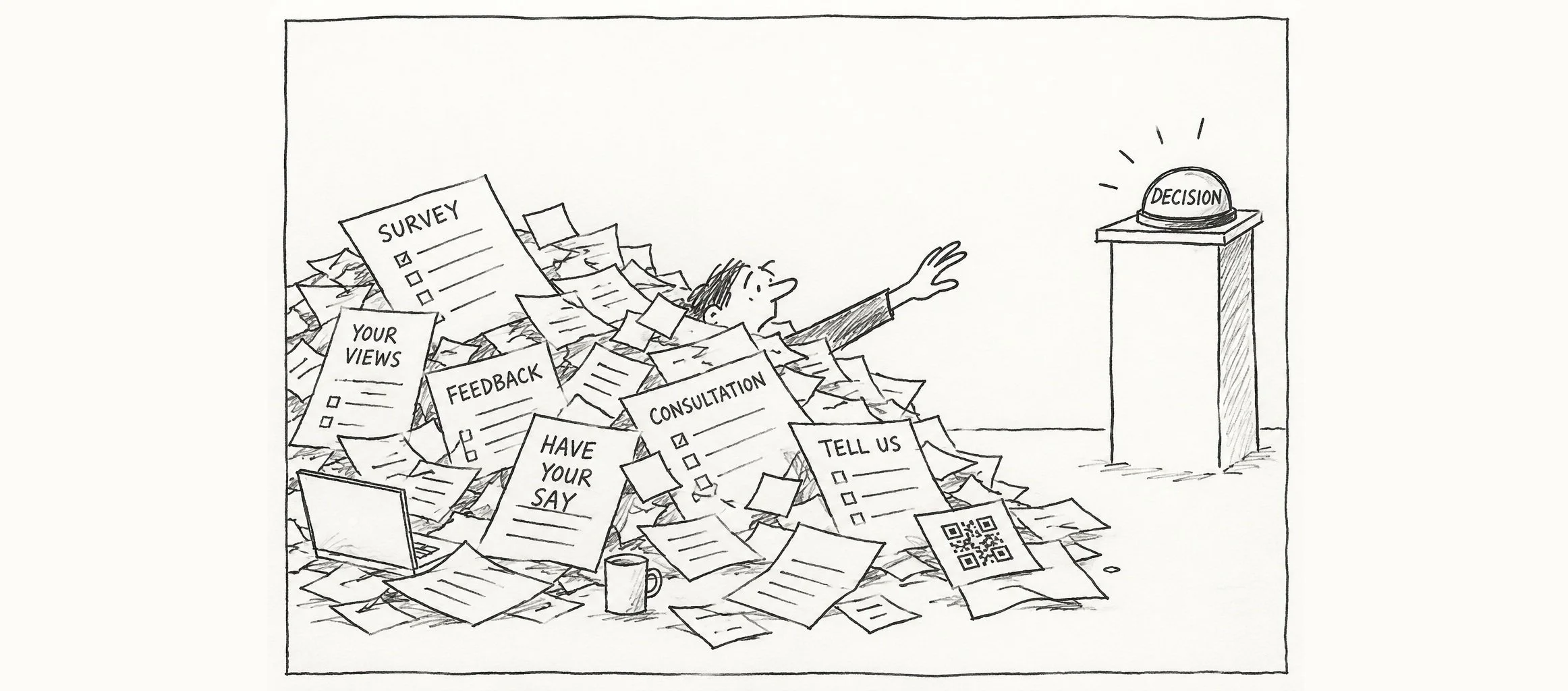
And perhaps there is a danger that the more energy and resource we put into these consultation models, the less we put into a different question: why are we continually trying to understand people better so that we can make better decisions on their behalf, rather than share more of the decision-making with them?
Knowledge matters. But knowledge isn't the same as power. Power is the ability to make and carry out decisions. That's the thing we need to get much better at sharing.
3. Where is the agency?
Perhaps the most interesting tension in the report is around agency.
The report itself identifies “a lack of agency” as one of the drivers of Britain's current malaise: more than a third of people feel their actions barely influence society and three-quarters feel the same about government.
Yet the report’s own methodology and intentions, retain an all too familiar distribution of power: people provide insight; institutions interpret it and make the decisions. It’s a model which arguably contributes to the lack of agency the report itself identifies, and not just in the cultural sector.
What if the response to lack of agency isn't simply to understand people better so that institutions can make better decisions? What if part of the response is enabling people to exercise greater agency within those decisions themselves?
That shifts the question from “What do people need from us?” towards something more fundamental. What decisions should people themselves be able to make about cultural life, resources and institutions?
In most sectors, organisations and institutions which already hold resources and power spend a lot of time and money finding out what people think.
What if more of that time and money went instead into changing who gets to make the decisions, on a permanent basis.
4. What might an alternative methodology look like?
The report shouldn't be expected to answer this question. It is an audience-research project, and its authors are unusually clear that it is a starting point. Their proposed “ready reckoner” comes with what they call a “significant caveat”: the resulting framework is a “starting hypothesis rather than a finished tool.”
My worry is that this just becomes a call for a load more consultation and research: spending ever more resources trying to find out what people think.
No doubt that will include more premises and parameters created by professionals rather than communities, while the sector will get to interpret the answers…and so we continue to actively feed into a cycle of people not having agency.
No wonder people say they’re sick of being consulted to death.
The report ends with a helpful invitation:
“If this report is useful, it will be because it starts an argument rather than settles one.”
The argument I think we need to have is whether we should keep spending ever more resource trying to understand people better so that organisations and governments can make better decisions on their behalf, or whether we should start investing in permanently different leadership and decision-making structures in which people don't simply provide views, but share power to decide what happens.